Showing posts with label Playability. Show all posts

The Pursuit of Perfection

May 4, 2018 The Uh-Oh Moment
The beauty and elegance of golf is that it is played outside in nature. Along with the beauty of enjoying the great game of golf outside comes the challenge of dealing with the rough weather. As the debate of climate change roils on, it is clear that weather patterns in the last couple decades have been extreme. Extreme in force and extreme in variation. Working on a golf course places a person on the front line of these extreme weather events, some call it the new normal.

The 2018 golf season started on October 30, 2017. A massive wind storm roared through Stowe on this day and forever changed the landscape of our town. While The Mountain Course did not suffer any significant damage, Stowe Country Club took a direct hit from the fierce winds. The damage centered around trees and more specifically white pine trees. The white pines at SCC are considered "burly" or "pasture" pines. This designation refers to the structure of a white pine when it grows in an open environment. The tree tends to have many large branches and multiple main stems or leaders. These large trees are ever-present at SCC and whenever the wind blows they shed branches, both large and small. The tree litter and complete blow downs after this historic storm was substantial.

One of many white pine branches on October 30, 2017
Our team arrived back to work in late April 2018. For two weeks we cleaned up the mess from this epic storm. While there are many other chores to do in the spring on a golf course, we endlessly picked up white pine tree debris. After that massive clean-up effort we rallied to open SCC. With all systems go, the unthinkable happened the night before we opened. Another wind storm slammed down on northern Vermont. We were shocked to put it lightly. This storm pummeled us. White pines were once again our enemy number one. The golf course looked like a war zone. Branches everywhere, whole trees down, tops of trees blown off, and huge main branches broken off lying on the ground. The reaction of the team after dealing with now two major wind storms before we even opened for the 2018 golf season was silence. We were stunned and at a loss for words!

We opened up on schedule that first Saturday in May. It was surreal to say the least. For golf course superintendents, our daily mode of operation is the pursuit of perfection. What defines perfection depends on many different factors. On this opening day in 2018 at Stowe Country Club, with the course in complete disarray, it was perfect because the sun was shining and we were golfing once again after a long winter. Cheers to opening day in 2019. We anxiously await what it brings.

Winter work: Crucial for a successful golf season

A common question asked by golfers and non-golfers alike is, "What do you do in the winter?" This question used to annoy me, as I felt the person asking the question was being cynical or critical.  Over time I have come to realize that most people really have no idea what a golf course superintendent and team does in the summer, let alone in the winter. Now, when someone asks me what do we do in the winter, I take the time and explain this unique world of a golf course superintendent and greenkeeping.

Since our golf season in northern Vermont is relatively short -- from early May until late October -- proper preparation leading up to the beginning of the golf season is crucial. We take advantage of winter "down time" to "put the course to bed" properly in November and then spend the balance of the winter and early spring preparing for the intense six month golf season ahead. 

A look at the winter of 2017/18 provides a great example of the work we do.

Equipment
Our fleet of turf care equipment includes very specialized machines. The cost for one mower can run anywhere from $50,000 to $70,000. The replacement value of an average eighteen hole golf course equipment fleet can easily reach and exceed $1 million. Our goal in the winter is to look over each piece with a fine tooth comb and do all the preventive maintenance necessary to withstand six to eight months of constant use. Without this thorough winter maintenance the risk of a mid-season breakdown becomes much more likely. Avoiding a major mid-season repair is our goal.
Reels are ground and ready to go.
Grinders on the sides of photo. 

Quality of cut is of high importance to us. The majority of our mowing fleet are reel mowers. A reel mower is used because it can mow turf at low heights due to a cutting action like a scissor. A reel with multiple blades spins at high speeds while a stationary bedknife rides along the ground creating a cutting effect. Both reel blades and bedknives need to be precision ground at least once a year during the winter. This precision grinding is done on specialized grinding lathes in our shops. Think of this grinding process like the way skis and snowboards are ground. Sharp edges with proper angles are needed for the equipment to perform properly.

Brush Clearing and Tree Removal
Golf courses in New England are usually built within some type of forested setting. These forested settings, whether interior or exterior, want to grow. Without the occasional cutting back of the wood lines the forest will choke out the golf course.

Rocky hillside at SMC being cleared of brush.
At SMC, the team did great work cutting back the edges on hole seven, twelve, thirteen, and fourteen. A huge brush cutting project was also completed between hole sixteen and seventeen. This rocky hillside was cleared in 2004 to prepare for the construction of the course. Since then, all of the first growth species (cherry, birch, and poplar) vigorously grew back. This new look provides incredible views from sixteen tee and gives seventeen green a much better feel.

Cutting, clearing, and burning on fourth tee at SCC
At SCC, the team worked hard to cut back the edges on hole one and three. On the fourth hole the brush was cut back to the left of the teeing area. This cleared area will be the home of a new back tee. The October wind storm created multiple blow downs that needed to be cleaned up. The wooded area behind the fifth green was hit with six hemlocks that blew over due to the storm. After these areas were cleaned up, we continued with the tree removal program. Our efforts were focused on trees near greens and tees. The criteria for removing a tree has been laid out in a previous post SCC TREE REMOVAL PROGRAM . Most of the trees removed are white pine trees. These trees reduce the turf quality because of heavy shading, shallow roots, and copious amounts of tree litter. Along with better playing conditions the removal of white pines allows us to focus man-power on providing great conditions and not spending valuable time picking up pine needles, cones and branches. The added benefit is that previously obstructed mountain views are opened up.

Accessory Refurbishing
Production line of SMC tee markers
The winter months provide us the opportunity to take stock of all the accessories that are used on the golf course. Items like ball washers, bunker rakes, cart signs, and tee markers are refurbished to make look new again. This year it was determined that new tee markers were needed at both courses. In the spirit of good old fashion Yankee ingenuity and frugality we made them ourselves.

Painting SCC tee markers.
Notice the finished water cooler station in background.
At SMC, we made the markers out of white birch logs that came from the property. The logs were dried for several months, cut to size, spikes installed, and then the ends were painted. The natural look will fit in with our mountain golf course setting. At SCC, we used cedar posts cut into blocks for the tee marker. The cedar was stained, the sides painted with the appropriate color, and a spike was installed. Both teams did a great job paying close attention to detail and craftsmanship.

The other big in-house project at SCC was to build new water cooler stations. The old plastic stations were faded and simply had seen their day. These new stations were built by Mark Finch, SCC superintendent. Mark is a great woodworker and put his talents to work with these structures. This new look to the course will be striking.

One of six water cooler stations under construction.
Continuing Education
The "off" season provides us with the opportunity to attend conferences specific to turf and golf course management. At these events, the networking amongst fellow industry professionals and the educational classes are extremely valuable for our professional development. There are two premier conferences that are not to be missed. The Golf Industry Show put on by the Golf Course Superintendents Association of America is an incredible educational experience. This year it was held in San Antonio, TX and attended by 12,000 golf course industry professionals from all over the world. The trade show and educational opportunities are exceptional. The second conference is put on by the New England Regional Turfgrass Foundation and is annually held in Providence, RI. This conference and trade show provide a more regional educational experience.

With spring now upon us, we feel confident and ready for the new golf season ahead. It has been a busy few months at both courses. Our good work this winter will soon be available for all to enjoy as opening day is fast approaching. We hope you enjoy our winter work as much as we enjoy doing it. See you soon and have fun out there!

2017 In Review

Typical storm front this spring/early summer headed for Stowe!
The 2017 golf season did not disappoint with any lack of storyline. When reviewing a golf season in the northeast the weather will always be the main topic. The months of May, June and July brought copious amounts of rain. This period set records with rainfall amounts and most continuous days with rainfall. The total rainfall for this three month period was 25 inches. Compare that number to the annual average rainfall in Vermont of 36 inches and you realize the abnormality. While rain is not good for playing golf, working in it is equally not good. I applaud the agronomic teams for pushing through all those days working in the rain. It became the norm to put your raingear on when leaving the house in the early morning and still have it on arriving home from work. Let's just say Gore-Tex and rubber boots were your friend!

Moving into late summer we experienced some great weather. When fall arrived it was the complete opposite of the spring. The fall period set a new record for the most continuous days without rainfall. It was great golfing and working weather. While drainage systems were important in the spring, in the fall the irrigation system became a crucial tool for great conditions.

White pine blow down next to 12 green
As to not disappoint before year end, Mother Nature unleashed a powerful windstorm on October 31st that caused significant damage in Stowe and surrounding towns. Stowe Mountain Club received very little damage from the storm. At Stowe Country Club it was another story. Many mature pine trees were broken in half and uprooted. Multiple pines lost large limbs and there was a massive amounts of tree litter that fell everywhere. There is no doubt we will be cleaning up from this storm well into the spring of next year.  I've been working on golf courses for close to 30 years and Mother Nature continues to be the one true challenge year after year. There are some years when she plays nice but there are just as many when she lets everyone know who is in charge.

Mark Finch, SCC Superintendent, dormant seeding greens
Even with the wet start both Stowe Country Club and Stowe Mountain Club continued to improve the turf quality and overall playability of the golf courses. It is our goal to always improve and never settle for average. I have always believed in the saying that "good is the enemy of great" and the agronomic team operates in such a way. Each golf course continues to improve by adhering to solid agronomic practices. The ongoing effort to topdress and verticut greens on a regular basis is crucial to providing smooth putting surfaces. Proper aerification practices continue to firm up the playing surface by removing thatch. Turf health is maintained through the use of best available nutrition and pest control products. One agronomic focus that continues at Stowe Mountain Club and Stowe Country Club is the push to grow and promote our creeping bentgrass populations. Creeping bentgrass provides a great playing surface on the greens and fairways. At SMC it is a matter of maintaining the existing bentgrass while at SCC it is about promoting bentgrass. A new process was initiated at SCC this fall to promote bentgrass on the greens. After the course closed for the year the greens were aerated with an eight inch deep solid tine then core aerated with a traditional 3/8 inch hollow tine followed by a topdressing with sand. After this process was complete a specialized seeder planted a high quality creeping bentgrass seed. This type of seeding is referred to as "dormant" seeding. The process involves the seed overwintering as seed and then germinating in the spring when conditions become conducive to growth. This agronomic practice will increase the bentgrass populations on the greens at SCC leading to a better putting surface in the long term.

Sean Hanley laser grading 15 tee tops
At Stowe Country Club, there were multiple projects that occurred this year. The biggest was the renovation of the fifteenth tee complex. This area had been overrun with white pine trees and the teeing surface was mounded due to years of divot mix accumulation. While local and regional contractors were used on the job much of the work was done by the SCC team. Myself, Mark Finch, and crew members worked tirelessly to get this job done on time for the Kirkwood tournament. Much of the work was done in ankle deep mud during the pouring rain. This in-house work included irrigation/drainage installation, sodding, cart path preparation, and finish detail work. In-house construction projects are difficult because of the effort needed to simultaneously stay on top of the routine course maintenance work. We did also rely on the expertise of two regional golf course contractors. NMP Golf  Construction provided a shaper to do the major site work. A good "shaper" is the key to any successful golf construction job. These bulldozer operators have the eye for how a golf hole should look and play. Sean Hanley from On-Course Golf came in for the final laser grading of the tee surfaces. Sean is the contractor that built our upper driving range tee. This new tee and fourteenth green surround has received much praise from the players. As the area matures it will become an even better playing experience. Thanks to all involved in a great project.

Renovation of 15 bunker
Other projects at SCC included the renovation of the second and fifteenth bunkers, four bunkers in total. These projects were completed by the SCC crew. It has been a priority in recent years to renovate a few bunkers every year. The reason for these renovations include poor drainage, continued washout of bunker sand, and loss of contours due to time.  The renovation process involves establishing new outside contour lines, removing old sand, shaping out new bunker floor contours, installing drainage if needed, and  adding new sand that is specified for bunkers. Additional projects included a new cart path on the fifteenth hole that complemented the renovation of the tee and repairing the cart path around the practice green at the clubhouse. The clubhouse landscaping was renovated. Much of the landscaping lost all interest due to over grown lilac trees. Finally, the irrigation pond was dredged.

Spectacular course conditions at SMC
While SMC was not as active with projects, the season was defined by superb conditions. The agronomic team headed by assistant superintendent Zach Fleeger pushed for championship conditions on a daily basis. We heard great comments from the members and players all season. The winter brush cutting done by Zach and fellow assistant Jerry Elliott on the fourteenth and third hole were well received and gave these two holes a fresh new look and feel. Look for more of this great work during the upcoming winter.

As we move into the winter season there are some great projects we plan to accomplish that will continue to improve the golfing experience at both Stowe Mountain Club and Stowe Country Club. I will update the blog through the winter to discuss these projects. Be sure to enter your email on the blog homepage for up to date blog posts. Thanks to all who made the 2017 a successful year on the golf course. All the best to everyone during this holiday season. See you on the slopes or someplace warm playing some golf!


Winter Update

Turf Health
As winter fades away and spring arrives the agronomic team is always focused on how well the golf course turf has survived the harsh winter weather. You may be surprised to learn that this winter was one of the warmest on record. It is hard to believe because December was exceptionally snowy, and showed signs of a long winter ahead, but January ended up having little snowfall and warmer temperatures. February had some snowy weather but was also fairly mild. Now March has been frigid and snowy.

The early snow was good for the turf. Snow provides a layer of protection that allows the turf to breathe. The biggest obstacle to winter turf survival is ice formation. While snow allows for air exchange, the ice layer seals off any ability for the turf to breathe which smothers and kills the turf. There are many variables when it comes to winterkill but the biggest variable is  length of ice cover. The January weather did bring some rain and thaw creating ice. Stowe Country Club (SCC), being at a lower elevation, experienced greater thaws than Stowe Mountain Club (SMC). The eventual total loss of ice and snow due to these thaws has us believing winter damage at SCC will be minimal. SMC has had snow cover on most of the course since late November. The winter thaws produced some melt which created ice under the snow. This scenario provides a higher chance of damage. It is still too early to know with any certainty what we will look like in the spring. The creeping bentgrass varieties at SMC are tolerant of some ice cover. We will have a clearer picture at SMC as April arrives. To assist with survival the team will begin to remove snow from greens in the upcoming weeks. 

SMC Work
Hole 14 rock feature being exposed
Hole 14 brush pile ready to burn
This winter the team focused on two projects that will improve the playing experience. On the fourteenth hole underbrush to the left of the fairway landing area was cleared. There is a large outcropping of rock that was not exposed when the trees leafed out. Opening this area up will give the golfer a feel of width and provide a stunning visual of the beautiful rock formation. One of the goals is to expose and accentuate the natural features and great vistas that SMC golf course property provides. 

On the third hole, focus was placed on pushing back the tree line to the right of the teeing area. These trees and brush were growing in on the golf hole pushing the payers to the left and blocking sight lines to the right side of the fairway. With this area now clear, the player can see the whole fairway and have a visual on balls that land just of the fairway. The overall feeling on the third tee will be much less restrictive and provide a better experience. 

This hard work was conducted by assistant superintendents Zach Fleeger and Jerry Elliot. Winter brush and tree clearing is essential to the long term sustainability of the golfing experience at SMC. The golf course was built throughout a young forest and the perimeter continues to aggressively grow in on the course. Without this work our unique and breathtaking vistas will begin to disappear and the turf quality will suffer from shading and restricted air flow. Winter is the best time to conduct this work, but access is a real challenge. Zach and Jerry spent much of the winter hiking out to these areas pulling a sled full of logging gear. With a thermos full of coffee they would spend the day working hard cutting brush and felling trees, then burning what they cut. This is not easy work in the deep snow on a windy mountain golf course. The motivation for us to initiate this difficult work is knowing we are preserving the beauty of  Stowe Mountain Club golf course for our members and guests to enjoy.  

SCC Work
Olsen House locker room finished product
There was a big effort put forth this winter inside the Olsen house. The Olsen house is the single family house set within the maintenance facility compound. It was purchased fifteen years ago when it went up for sale for the purpose of protecting the future integrity of the golf maintenance compound. Without this property the maintenance operation is severely restricted. With the purchase of the house came the ability for the grounds crew to have running water, a bathroom, and a clean place for lunch. Prior to the house the crew ate lunch in the equipment repair shop that is attached to the red barn. While the addition of the house was a step forward, it is still an old house meant to be lived in. It was not set up to be a space for thirteen grown men to work out of. Our work is dirty. We spend long hours with machinery, maintaining turf, moving soil, cutting brush, etc. The set up of the house is far from ideal for these duties. To add to this, no major renovation has ever been done. To cover up the years of grime every square inch of wall space was painted, areas of floor that get heavy use were painted with grey industrial floor paint, and the upstairs carpet was removed and a laminate floor was installed. The work was done on a small budget and meant to be a quick, inexpensive way to make the space more efficient and demonstrate a professional work space. All of this work was done by our team and while it helped create a sense of pride, it is by no means a permanent solution.

Hole 1 Spruce tree removed (Notice die-back on top)
Hole 16 trees removed (Notice top die-back and thinning)
Great on-course work was also conducted this winter. When there was good snow cover, we ventured out on the course with our tractor that is outfitted with tire chains to continue the important tree removal program. The goal is to remove trees that are diseased or damaged, block vistas, create excessive man hours to clean up debris, negatively impact turf quality, or negatively impact shot quality and choice. This year we removed diseased trees on the first tee and sixteenth rough. Additionally, three large white pines were removed next to the 8th tee. On top of the issues described above, these trees were over gown and impeding any future renovation of the tee. Furthermore, they blocked a great vista of the Worcester Range ridge line from the third tee. 

Two significant projects are currently under way and are scheduled to be substantially complete by opening day. The irrigation pond was dredged to increase storage capacity. The pond had a significant amount of silt accumulation due to the feeder stream dumping sediments into it. The warm winter weather forced our initial plan to be amended. Initially, the sediment was to be hauled off the golf course via an ice road across the first fairway. The ice road is created by packing the snow then plowing it for a few weeks. With the mild winter there was no snow to create the road. When we did get snow, by the time the road was ready it melted due to a thaw. The amended plan was to remove the sediment and stockpile it in between the first and ninth hole. This area of un-mown turf had little aesthetic quality. The sediment will be allowed to dry, shaped out with a bulldozer, and seeded to a good quality seed mix.

The second project is focused on the fourteenth green and fifteenth tee area. This area has been struggling for years because of the row of white pine trees growing close to the green and tee. These trees were planted to provide a border to the Village Green condominiums. At this point in time the pines have grown to a size that they negatively impact the golf course. The only option was their removal. With the pine trees gone, the fifteenth tee can be renovated. The turf on the tee has always struggled due to the close proximity of the trees. In addition, the tee suffers from mounding. This mounding is common in old par three tees because of years of divot mix building up in the middle of the tee. The new tee will have a sand based rootzone and be professionally leveled to provide an exceptional playing experience. The area behind the fourteenth green that was populated by the trees will be filled with dirt and a rolling mound will be installed. Fescue grass will be seeded on the mounds providing a great visual from the approach shot. While the new open look will be different it is the best decision for the long term enjoyment of these two golf holes.

With snow still on the ground, we are preparing for the first window of opportunity to complete these projects at both SMC and SCC. The entire agronomic team looks forward to presenting the final products to the players when the golf season arrives.

2016 Fall Recap

Wow! December has brought above average snowfall for Mount Mansfield this year. The skiing and riding is off to a great start. There are smiles all over the mountain. While the snow has everyone excited for early season fun on the slopes, it is a good time to take a look back at the 2016 golfing season and the activity of the grounds staff.

2016 Headline

The headline story for golf course conditions in Vermont and all of New England was the drought. Many golf courses suffered through the last part of the golf season with diminished to depleted irrigation water supplies. This lead to some turf loss due to extreme drought stress. Stowe Mountain Club (SMC) fared well with the drought. Our water supply comes from Peregrine Lake. Peregrine lake was designed for snow making reserves and holds 111 million gallons of water. For comparison, the golf course will only use 10 million on a very dry year. Coupled with a substantial reserve of water, the irrigation system was designed to cover all playing surfaces from the cart path to the edge of the fescue grass. While Stowe Mountain Club is in a good position to handle drought conditions, the situation at Stowe Country Club (SCC) is much different.

SCC Pond Drained and Ready For Winter Dredging
The pond on the ninth hole is the irrigation water source at SCC. This pond has a holding capacity of 1 million gallons. This size pond is a very small storage capacity for a golf course. What makes the pond usable is the fact that it is fed by a stream that enters the property from the first hole. The issue that occurs in the late summer is that the stream dries up and the pond cannot be recharged. This year we began rationing water in late August and continued through the dry September with minimal capacity to irrigate. Thanks to the hard work of Mark Finch and Matt Jung we hung on during these difficult times and the conditions did not suffer greatly. We did have to suspend the washing of equipment in mid-September because the equipment wash pad is fed by irrigation water. This became an operational challenge but we decided it was necessary to conserve the little water that was left in the pond for turf health.  

Strides are being made to eliminate this unfavorable scenario in the future. One very important water conservation tool installed this summer was the replacement of the old irrigation controllers (See prior blog post). The new controllers with centralized control allowed for precise programing of nightly irrigation cycles. This new system ensures very little waste in irrigation water and reduces the overall electrical consumption of the pump station. This winter we will be dredging the pond to regain water storage capacity. The stream that feeds the pond carries sediment that overtime has filled in the pond. The contractor will do this work in late winter to minimize the damage to the golf course. Lastly, we are designing a pumping system that will utilize the water from the West Branch of the Little River that runs along the fourteenth hole. This secondary water source will fill the irrigation pond when the feeder stream dries up. The pumping capacity of this pump is low enough to have no impact on the health of the river. These investments will assist us with providing great golf course conditions while using the latest technologies to conserve and use the water wisely.

Fall Projects

The fall is a great time to do small construction projects on the golf course. By this time of year  the grass has slowed so that mowing frequency has been reduced which frees up labor to be allocated to such projects. The bonus period for construction on the course occurs in November. By this time, the courses have closed and we have completed most of the winterization projects that are crucial for turf survival. November can be hit and miss when it comes to favorable working weather. This year the November weather gave us a small window to be productive on the golf courses.

SMC Hole 7 Curb Removal
13 Bunker Before
The difference in elevation between the two golf courses was very evident this fall. The weather turned cold and snowy much sooner at SMC than at SCC. As an early winter was setting in at SMC a project we were able to complete was the removal of the curb at the seventh tee. The curb was originally installed to manage cart traffic in order to minimize excessive wear to the turf. As time progressed it became clear that this curb was impacting play in a negative way. The ball from a long left tee shot on the sixth hole would end up catching this curb and rolling all the way to the eighth hole. While an errant shot should not be rewarded, a player should have the opportunity to find the ball and attempt a recovery shot. By removing the curb, a ball will now simply roll off the path onto the seventh tee surrounds providing a player with a manageable recovery opportunity.

13 Bunker During
With the weather window staying open for longer at SCC we initiated three projects. A drain line was installed at the practice facility to alleviate various standing water issues. This drainage project fixed a wet area near the closet target green from the upper tee. On this same pipe we connected a line that will capture water from Sinclair Road that would puddle near the newly paved parking lot. This was not a glamorous project but it was necessary to continue to improve our great practice facility. A second drainage project occurred at the fifth hole approach. A chronic wet area existed below the right green-side bunker. A drain line was installed to dry this area and various drainage laterals were installed to provide additional drainage in the approach. The final project was to repair the right side bunker at the thirteenth green. This bunker was one of the bunkers that puddled for a long period after a rain storm. Additionally, the size of the bunker had shrunk over time. To repair this bunker we installed a center drain line, expanded the contour lines, and added better performing bunker sand. This bunker repair is the continuation of our overall goal to provide great playing surfaces continuously across the entire golf course in all weather conditions.

13 Bunker Final
We look forward to presenting these improvements to the players this spring. Until then, enjoy this good old fashion winter weather!


Stowe Country Club Irrigation Update

Twenty-first Century Irrigation... What is it?
Golf course irrigation systems consist of three major infrastructure components.  At Stowe Country Club, we recently completed an overhaul and upgrade of one of these components; the control system.  The pumping system and the delivery system are the other two.  The means to deliver water to the turf is one of the most valuable tools a golf course has.  The superintendent is responsible for managing water usage to yield optimal conditions of playing surfaces.  Executing this simple principle requires that the superintendent relies on all three major components to be flawlessly operable.
A basic approach to appropriate watering practices is simply to not over-water.  This is done for many reasons that include playing conditions, disease management, resource conservation, and more. It is crucial that watering occurs only when necessary and not only when convenient.  This brings to light the importance of the system and its components to be functional during crucial demand periods.
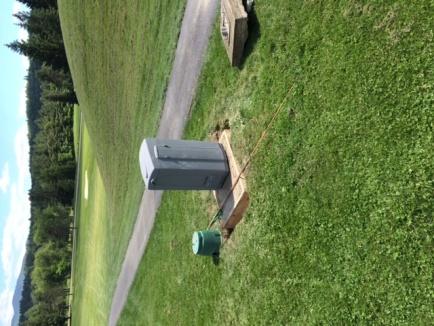
The irrigation system that is in use at Stowe Country Club is over twenty-five years old which poses great concern for possible failure.  We had the opportunity to upgrade the control portion of the system this summer. This is essentially the brain of the system and consists of a series of electrical field controllers that transmit electricity to each of the hundreds of sprinkler valves throughout the golf course to deliver water.  Using the seven former field controllers at SCC as stand-alone programmable controllers is an example of the most basic application of automated irrigation.  Until a week ago our assistant superintendent, Matt Jung, would make a visit to each field controller nearly every day and manually program the watering schedule.  This is analogous to setting 168 alarm clocks each evening but they cannot all go off at once, they have to be spread apart so as not to get so loud it wakes the neighbors.

C:\Users\mfinch\Desktop\IMG_1441.JPG


Previous stand-alone controller on hole 10


C:\Users\mfinch\Desktop\IMG_1442.JPG


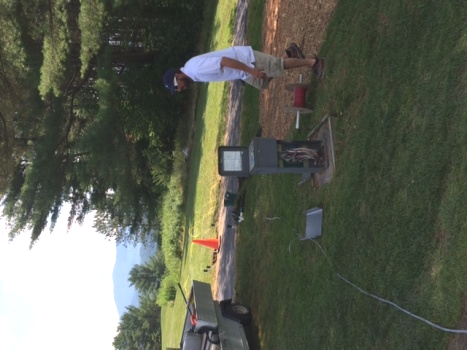
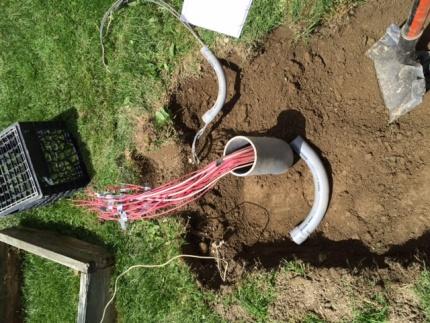
Installation in progress


C:\Users\mfinch\Desktop\IMG_1443.JPG  

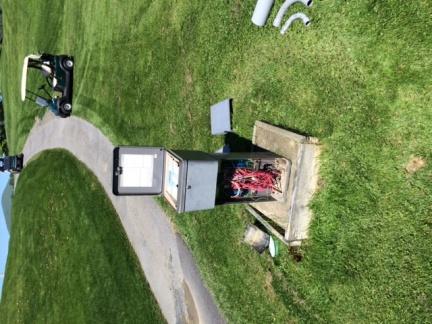
Newly installed controller with new concrete pad and surge grounding
The pumping system has a maximum supply threshold of delivering 450 gallons per minute (GPM).  If there is too much overlap in the number of open valves that are demanding water during the nightly watering schedule, an alarm is activated and the pumps shut off before they are damaged.  The pumps will live to see another day but the irrigation schedule that was interrupted is now incomplete.  Most full watering cycles take 5-10 hours to run which is why an automated night time schedule is the only feasible run time.
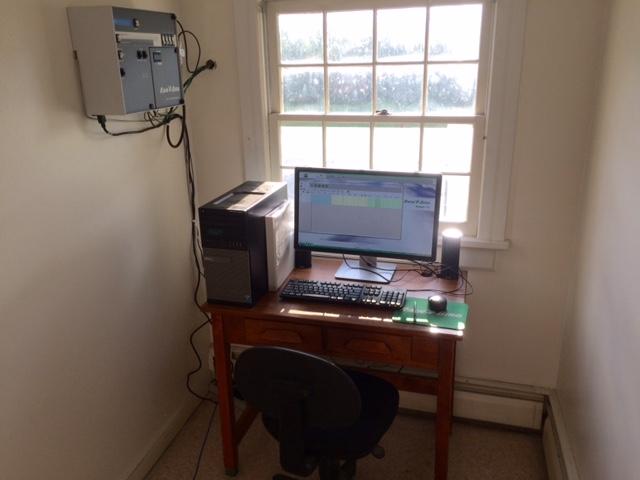
The control system that we installed this July incorporates a central controller in the form of a computer that communicates to each of the seven new field controllers via radio frequency.  The central computer uses smart technology to schedule and facilitate the automated watering.  The central component creates a cycle schedule based on our daily parameters that maximizes the efficiency of the pumping system and its electricity consumption.  It monitors theoretical GPM flow in real time and adjusts watering in the field to consolidate running time while also avoiding overuse of the pumps.

C:\Users\mfinch\Desktop\IMG_1547.JPG


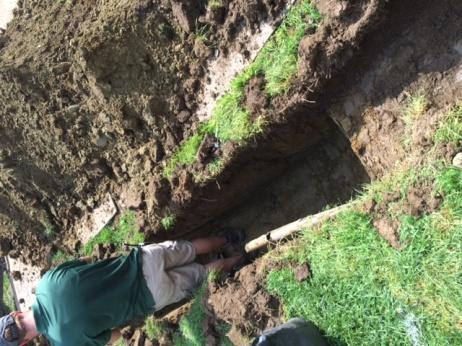
burying surge grounding rod


C:\Users\mfinch\Desktop\IMG_1550.JPG

Previous controller on hole 1 in area of play.


C:\Users\mfinch\Desktop\IMG_1714.JPG

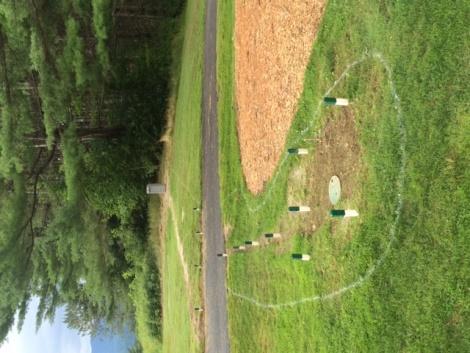
Newly located controller site out of play.  
(We anticipated this relocation and dropped a sleeve tube
underground to run wires through prior to cart path paving in May.)
The entire irrigation system benefits from this technology.  Knowing that all three major system components are aging and their reliability is questionable, we concluded that the smart features of the central control will help preserve the longevity of the system as a whole.  By prioritizing the control system upgrade we can confidently rely on the pumps to run at a more consistent speed or RPM, reducing wear and tear and reducing run time hours.  By maintaining a constant pumping speed and maximizing the demand of the available GPM flow, our underground piping system is moving a more steady flow and a holding a more static pressure level. Without central monitoring, water flow in the underground pipe can be variable and sporadic and can cause stress fractures and catastrophic breaks, especially in 25 year old PVC pipe.
C:\Users\mfinch\Desktop\FullSizeRender.jpgC:\Users\mfinch\Desktop\IMG_1713.PNG
Left: the central control computer set up in the maintenance office.  
Right: a screenshot of my cell phone utilizing an app that can communicate
with the central control computer remotely.

The control system is up and running and programming is as simple as a mouse click or as complex as we can fathom.  In an industry where water is a diminishing resource in some regions, it is our responsibility as superintendents to be conservative, efficient, and accurate in our watering practices.  There is an endless amount of data that we have begun uploading to our central control that will make our system operate optimally.  As we build our database we will begin to employ features of the control that communicate with our weather station to maximize water use efficiency.  For example, the watering schedule can be set to pause or end at the detection of rain.  The weather station will also feed data that measures the amount of evapotranspiration (plant moisture loss during day) and determine the amount of irrigation to apply to replenish vapor loss.  These are good examples of technology opening up a whole realm of new ways to increase accuracy and efficiency.  Not to mention, the ability to operate the sprinklers on the golf course remotely from anywhere in the world with our cell phones!

Mark Finch, Golf Course Superintendent

Winter Reflection at Stowe Mountain Club

While snow depths stayed low all winter season, the grounds department was able to prepare and complete some great projects on the golf course. It also halted the stress of true turf management, allowing our team to continue exploring opportunities to improve your golfing experience. Arguably, the winter months are some of the most important months for a golf course maintenance team. On the surface, it may seem like our main priority is only snow removal, but our scope of work extends far beyond. Refining the maintenance operation, analyzing the budget, and most importantly researching our team output on the property allows us to prepare for another successful golf season.
2 tee underbrush
Obstructed view on 18

This particular winter season, we identified 2 particular projects. Tees on holes 2 and 18 needed a facelift. Our goal was to improve turf health and aesthetic value. Like any project on the golf course, there is necessary research that needs to be completed before the start. On top of analyzing the budget, we make sure that the project will benefit the health of the surrounding turf. Most of the time the aesthetic value will also be immediately enhanced, but sometimes it may take a few weeks to a few months for the surrounding turf condition to also improve. As you'll be able to see during your round, our work significantly improves the aesthetic value of the holes. Over time, this work will also improve the health of the surrounding turf. The work on 2 tee opens up views to Peregrine Lake and the work on 18 opens up a view of "The Chin" on Mt. Mansfield and a beautiful rock face. The brush cleared on 18 tee also improves the playability from the black/blue tees (playing a right to left shot).
Cleared view of the "chin"on 18
Cutting brush under 2 tee
Clearing underbrush this winter, particularly from tee surrounds, was an on-course priority. As I mentioned before, this particular act can help health and aesthetic value. By clearing brush, this will
dynamically enhance air flow and circulation. By enhancing these two things, the turf will have more sunlight and oxygen improving its ability to make more food for itself. Organically, the turf plant will also be able to improve its natural defenses, potentially decreasing overall pesticide usage.

Burning brush
We were then able to discard the removed brush by naturally burning. However, you will notice some standing "dead" trees remaining in the cleared areas. We refer to these "dead" trees as"snags." The "snags" are necessary in providing habitat for wildlife such as woodpeckers. The "snags" allow the woodpeckers to create cavities. These cavities allow smaller birds to occupy these spaces to nest called "cavity nesting." During this whole process we were able to partner with the Mountain Operation Team and borrow a tracked vehicle to access the golf course during the winter months. The sharing of assets between resort departments is really proving to be a valuable process for everyone involved. Sharing assets primarily helps the bottom line when analyzing the necessary inputs needed for these capital projects. This on-course winter work is very important because the forest will continue to grow in on the golf course, negatively impacting playability and aesthetic value.
A look at the final product
Thank you for your continued support! We look forward to your feedback regarding these winter projects!

A Short Look Back and a Long Look Forward

The 2014 Golf Season was defined by the epic level of turf injury that occurred from the severe winter weather of the "Polar Vortex". Widespread turf loss was reported throughout the Northeast and Canada. Unfortunately, six greens at each of Stowe's courses experienced some type of turf loss. The areas that experienced the most damage were greens seven and thirteen at Stowe Mountain Club (SMC) and twelve and thirteen at Stowe Country Club (SCC). Fairway damage was also significant at each course. While many golf courses suffered for months with visible damage it was hard to find any damage on either of Stowe's courses by late June. The hard work and diligence of both crews  is commendable.

Late Fall of 2014 was a productive time at SCC with focus on drainage, infrastructure repair, and tree management. Most projects on the to-do list were completed with exception being the repair to the green-side bunker on the ninth hole. Completed was the repair to the bunker on one green and the fairway bunker on eighteen. Good sand and new drainage were installed, and the bunkers will play and look better in any type of weather. The re-contouring of the bunker on eighteen provides an important architectural feature-the hazard is now visible from the tee.

Re-contouring SCC 18 Fairway Bunker
Last season a tremendous amount of work went into improving the drainage at both courses. "Slit drainage" was installed in multiple areas. Slit drainage utilizes a unique two inch pipe that is back filled with straight sand. This design has proven its success on our clay based soils. The fairway drainage on nine and eighteen will now allow for firmer playing conditions especially during extended wet periods.
  
Installing Drainage SMC 14 Fairway
The unique location of the SMC course provides a challenge for turf survival due to the length and intensity of the winter weather. We are continually developing new methods and practices to prevent winter kill. Keeping the playing surfaces free of standing water is paramount to good in-season playing conditions and winter survival. At the SMC course, fairway drainage work was initiated on eleven, fourteen, and fifteen. Many of the new drainage lines were left open for the winter to assist in water movement during the spring thaw. These areas will be recovered before opening day. 

This winter we have been busy with the continued implementation of the SCC tree management program. For more information and to review this program, read the blog posted on 5/11/14. As it was last year, the focus this winter is on damaged trees that pose a safety hazard and trees that are overgrown and impacting play and the aesthetic of the course.

Golf is a game of options. Many of the trees found next to teeing grounds force the player to play only one type of shot. Opening up the tee shot to multiple options is a sign of a well designed golf course. For example, two white pines were recently removed from the ninth tee. These two white pines forced play to the left from the white and blue tee box. From the back tee, the tee shot was exceptionally narrow due to the overgrown canopy. Players now have the option to draw or fade the ball into the landing area. The next trees to be removed will be the white pines behind the sixteenth green. These four trees have been damaged by the violent storms that have rolled through the area in the past decade. The interior of the trees have signs of rot and are deemed hazardous. 

White Pine behind SCC 16 green with severe
structural damage and rot
From an architectural perspective the number sixteen green sits atop a beautiful rise that provides a panoramic view. It is a common misnomer that all golf greens need some type of backdrop for the purposes of "framing". While in some cases a frame provides focus and depth, in others an open sight-line behind a green can also provides an exciting challenge for golfers. In researching the course history the architect, William F. Mitchell, did not intend for this particular green complex to have a backdrop of trees. As a result, no replacement plan is in place once these damaged trees are cleared.

The Stowe Golf Agronomic Team is excited for the upcoming 2015 golf season and we hope the winter weather is as good to the golf courses as it has been to the skiers and riders. While we continue to enjoy the winter season, we will continue working hard at both Stowe Country Club and Stowe Mountain Club. 

Fescue Revitilization Project

    Approximately ten years ago Stowe Country Club created a plan to stop mowing selected rough areas to reduce operational costs associated with mowing. These areas were previously mowed at the rough height of 2.5 inches. The savings were created by less fuel from the reduced acreage and in the reduction of man hours it took to mow. Additionally, there was less wear on the mowing equipment. A second aspect of this plan was to add a new aesthetic to the golf holes. 
    This new aesthetic aspect for the golf course is where the plan fell short. While the idea was good, the execution lacked follow through. As time progressed, the high rough areas were overrun with field grasses and weeds which resembled an unkempt pasture. From a golfing aspect, finding a golf ball in the weeds and thick pasture grass was almost impossible. The other negative aspect is that the look of weedy high grass areas presented the impression of neglect. Playing a golf course that has clean visual lines is a pleasant and inspirational experience. The opposite feels chaotic and distracting. 
    Earlier this year, a plan was initiated to revitalize these high grass areas to add a positive aesthetic to the course in addition to making them more playable. The plan is centered to promote the growth and establishment of fescue grasses. Fescue is a thin bladed grass that predominates on golf courses throughout Scotland, England, Ireland, and Wales. In these regions, fescue is a definitive characteristic of a links golf course. The actual playing surfaces, greens, tees, and fairways, are fescue on these European courses. However, the true charm and beauty of a links course is the un-mown fescue that surrounds a golf hole. The wispy seed stalks of fescue that turn a golden brown starting in mid-summer create the true beauty of a links course. Of course, fescue is not just on links courses. Many golf courses, wherever the region, have fescue in the outer rough areas to provide that beautiful flowing golden look.  The 2015 US Open will be played at Chambers Bay in Washington. This golf course is built on an abandoned quarry and was planted to fescue. Greens, tees, fairways, and rough are pure fescue stands. From it's inception, Stowe Mountain Club focused on maintaining expansive stands of fescue that frame many of the golf holes. The aesthetic created by the fescue during this time of year is beautiful. Besides the aesthetics, the other important aspect of fescue is the ease to find your golf ball and to successfully advance it. This is accomplished by planting fescue on low quality soil, never irrigating, and never fertilizing the grass. The thinner the better. 
Elimination of non-desirable grass surrounding thriving fescue
Between the 6th green and 7th tee
    The challenge at Stowe Country Club is that the fescue areas are overgrown with weeds and non-fescue grass and the soil has high water retention and nutrient holding capacity. Elimination of the weeds and field grasses is being executed with products that will eliminate all the undesirable plants but the fescue. Multiple applications are needed since many weeds and non-fescue grasses can be very persistent. Multiple mowing is another aspect of the revitalization of the fescue. Multiple mowing throughout the year will eliminate the ability for weeds to seed out, and will cause the depletion of the carbohydrate reserve of the plant that will eventually lead to the plants decline. The mowing will conversely help the fescue thrive and spread. Check out the recent USGA article on this topic. USGA ARTICLE
    This process takes time. Expansive stands of fescue at Stowe Country Club will take three to five years. As these areas are denuded of undesirable plants, new fescue will be sown. Maturation of fescue after establishment is slow taking three to four years. We appreciate your patience during this conversion. The end product will be worth the time and effort. Once established, the fescue will provide a beautiful aesthetic to a round of golf and it may even lower your score. For more information on fescue, visit a prior blog titled "Fescue".